|
Southern France in summer! Not only is it very hot but also a meeting place
for tourists from all directions or, as the French say, "tout le
monde" (the whole world) is on the move. In August, the French enjoy
themselves too because it is also holiday time in the "Grande
Nation" itself.
The results are full camping sites and holiday areas and in this period
everywhere looks like a fairground. You must not think that this phenomenon is
just the preserve of the "Côte d'Azur" tourist areas because
the convoys of cars, motorcycles and campers trail right back beyond the
coastal region - to the fantastic landscape of Provence.
Our goal was to discover the south of France, its landscape, the life of its
people and above all to be away from clogged roads and package tourists.
The solution was somewhere that is virtually a blank area on the blue, white and
red map, even for many Frenchmen - the Cévennes. These southern
foothills of the Massif Central are thinly populated like no other region in
the whole of France.
We leave the Rhone valley early on, turn behind Valence
in the direction of Privas and via Aubenas we arrive at the small town of
Villefort on the northern edge of the Cévennes National Park. A few
kilometres beyond Villefort, and a little off the beaten track is an idyllic
camp-site in the Palhère valley.
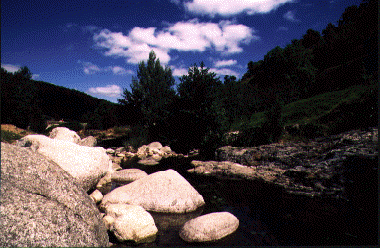 The landscape is covered in a lush vegetation and the large, round granite
boulders in the riverbed are like forgotten marbles left by the water-spirits.
The landscape is covered in a lush vegetation and the large, round granite
boulders in the riverbed are like forgotten marbles left by the water-spirits.
We take our shoes and socks off and paddle in the cold, clear water - water
that is full of life, just like the whole area that offers the marvellous
sight of undisturbed nature. Dragonflies buzz low over the water and since our
childhood we have not seen such hand-sized swallowtail butterflies.
Against all this, the Villefort reservoir is a real disappointment. Although a
road runs right along the edge, there is almost no possibility for swimming.
So, the swimming costumes stay packed and we turn our Enduros onto a small
side-road for which even the Michelin map has no number.
As we break free of the forest, a fantastic view opens up of the lake far below.
From the lakeside it's boring - but from up here, we now see the blue water
winding impressively through the valley.
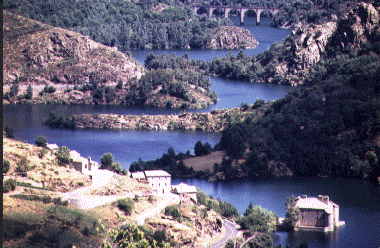
We must first absorb the unbelievable stillness that rules over these mountains.
No sound of the busy valley road reaches us here.
The surroundings look wild and undisturbed but when one looks hard enough,
there are signs everywhere of earlier habitation.
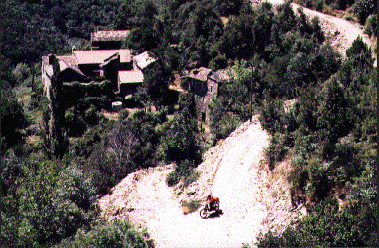 There are many abandoned farmsteads, the remains of stone walls
that supported terraces of workable land and a large number of chestnut
trees - a former "staff of life" of the Cévennes.
There are many abandoned farmsteads, the remains of stone walls
that supported terraces of workable land and a large number of chestnut
trees - a former "staff of life" of the Cévennes.
Whole families and their cattle needed the chestnuts for the long winter
because the meagre land could not grow enough corn for the whole year. The
sweet chestnuts were boiled, soaked or eaten raw and, from chestnut flour,
even bread was baked. The surplus, and the husks, were fed to the animals. The
wood was used for heating or for making furniture. Understandably, the farmers
of the Cévennes took great care of the chestnut groves but,
nevertheless, these times have gone.
|
 Deutsche Version


